The Effortless Trap: Productive Struggle, AI, and the Illusion of Learning
In short. With AI advancing fast, educators face a dilemma: ban it or allow it. Evidence that it both helps and hurts learning only deepens the confusion. Placement and pacing make all the difference: used well, AI becomes a personalized tutor that never runs out of patience, putting real power in educators' hands and stronger tools in students' minds. Used wrong, it creates only an illusion of learning. The article gives a simple map for that choice: six moves of learning, the two places AI must stay out, and the guarded uses where it can multiply feedback, examples, and practice.
Every teacher now faces the educator’s dilemma about AI: allow the tool or ban it. That is a false choice. Ban it and you give up the biggest boost to learning in a generation. Allow it freely and students hand the hard part to a machine and call it studying. There is a better, middle way. With the right pacing, choosing where you hold AI back and where you let it in, you get both: the struggle that builds the skill and the boost that scales it. So where does AI belong in your lessons? We must differentiate where it helps a student build the skill, and where it quietly does the work for them instead.
Start with the ceiling, because it tells you what is possible. For most of history, the best education on earth was one devoted teacher beside one learner. Almost no one ever got it. It went to princes and prodigies, and everyone else made do.
Aristotle tutored Alexander of Macedon in person, from about the age of thirteen. A decade later, Alexander had conquered the known world. The greatest mind of the age, working as one boy’s private tutor: that was a thing exactly one boy could have.
Helen Keller lost her sight and hearing before she was two, and with them every door into language. Then Anne Sullivan sat with her, one to one, hand to hand, year after year, until a single word finally meant something. Keller went on to a university degree, wrote a dozen books, and built a life of public work. A child with no way in at all, given one devoted teacher, reached the top. That is the whole promise of teaching, written in a single life.
And the rarest teaching does not lift one student. It lifts a generation. One small school in Budapest, the Fasori Lutheran Gymnasium, sent into the twentieth century John von Neumann, who designed the logic that still sits inside almost every computer, and two future Nobel laureates, the physicist Eugene Wigner and the economist John Harsanyi. One school, one city, one generation. It came from a culture of teaching, hard problems set before the method and expectations set high, carried by teachers like László Rátz, who drilled von Neumann and Wigner in mathematics. The same thing happened again in our own time. Ryszard Szubartowski, one informatics teacher in Gdynia, coached his students to sixty medals at the international olympiads, thirty-three of them gold, and several of them went on to build OpenAI, its chief scientist among them. Netflix has announced a film about him.1 Places that teach like this have always been vanishingly rare.
And what these teachers gave is not a mystery, and not a gift you have to be born with. We can measure the effect, and we can name the method. Give an ordinary student a good tutor, one to one, and they climb by roughly 0.8 standard deviations, from the middle of the class up toward the top of it.23 Large, though short of the famous “two sigma” claim. The method is teachable. What never scaled was the cost: one skilled adult, hour after hour, for a single learner at a time. That is the supply and methodology problem, and no amount of dedication has ever made it cheap.
That cost is the real ceiling. The teachers in those stories gave more hours than any job could fairly ask, carried by sheer enthusiasm, and that is exactly why what they did is so hard to repeat. You cannot ask every teacher to work to exhaustion, or to spread the same attention across thirty students that those tutors gave to one. This is the line AI moves, and it moves in the teacher’s hands, not behind their back. The parts of great tutoring that ate those hours are the parts that finally scale: the patient drilling, the instant feedback, the worked example on demand, for every student at once and at almost no cost. Hand those to the tool and a teacher’s scarcest hours come back, to spend where only a person can: judgement, mentoring, and the design of the lesson.4 Used this way, AI does not run the classroom. It lets an ordinary teacher give a whole room something closer to the attention only a few students ever got.
The same tool cuts the other way too. In one careful trial with high-school mathematics students, an AI helper that handed over answers during practice raised their scores while they had it, then left them about 17 percent worse on the exam they sat alone, worse than students who never used it at all. Rebuild that same AI to withhold answers and ask questions instead, and the harm vanished.5 Same machine, opposite result. The only thing that changed was where it sat in the learning.
The reason is simple, once you see it. Learning happens when the student does the hard part themselves: the effortful wrestling that researchers call productive struggle. An AI that does the hard part for them feels like help and is actually the opposite. Worse, it feels like learning while it happens. The work goes smoothly, the answers come out right, and the student walks away sure they have understood. The exam they sit alone says otherwise. The feeling of learning is a poor gauge. In one study, students in harder classes felt they learned less, even as they learned more.28 Smooth, easy practice can feel most productive exactly where it teaches the least. That is the effortless trap, and what it leaves behind is an illusion of learning: a confident sense of mastery that collapses the moment the support is pulled away. An AI built the other way, one that keeps students doing the hard part themselves but gives them more attempts at it and quicker, sharper feedback on each, is the tutor we have been missing.
A controlled study makes the split concrete. Software engineers given an AI assistant breezed through a coding task, then scored far below the unaided group on a quiz about the very code they had just produced, worst of all on finding its errors.30 Strong performance, little learning.
If the question is where, we have to look inside the learning itself. Picking up a new idea runs through six moves: Prime, Probe, Point, Attach, Strengthen, and Test. AI earns its place in some of them and wrecks others. What follows walks each move and shows where the tool helps and where it has to step back. One test carries the whole thing: if letting AI in makes the task feel effortless, it is probably in the wrong place.
1. The six moves
Picture what a student knows as a map: dots for ideas, lines for the links between them. Learning means growing a new dot and tying it firmly into the map. That tying-in is what makes knowledge deep: an idea woven into what you already know, one you can reach for and use. Skip it and you get the other kind, a fact sitting alone, linked to nothing, already fading out of memory. The six moves are how the first kind happens, in order. The figure below marks, for each move, what the teacher does, what AI may or may not do, and how the student’s knowledge map changes. Step through them.
Prime
The teacher sparks interest and asks the class to recall a few things they already know. The right corner of the map warms up.
Probe
A hard problem is set with no help. The student hunts through the map for ideas that might fit, some right, some wrong. The hunt is the struggle.
Point
Through questions, not answers, the teacher drops the wrong guesses and sharpens the right ones. Those concepts grow links that reach out, ready but empty.
Attach
Now the worked example arrives, a small new piece that snaps onto the waiting links. One older idea shifts a little to make room for it.
Strengthen
A second, slightly different problem puts the new piece to work. Its links thicken and weave into the nearby map. Fragile becomes firm.
Test
Finally the student faces the new idea alone, with no help. It holds up on its own. That standing-alone is the proof that learning really happened.
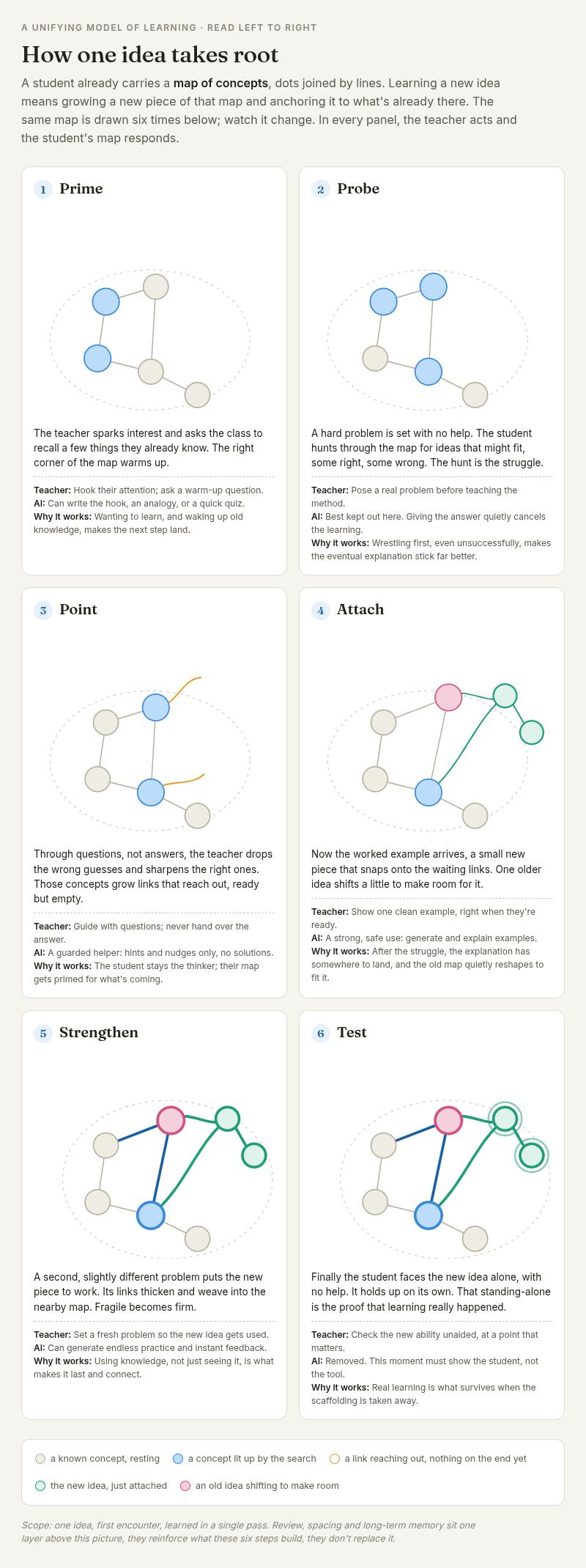
Step through it interactively, one move at a time
Interactive six-move model
Prime
Intervention (teacher)
AI on this move
Evidence
2. The one rule
The rule is simple. AI belongs wherever it adds feedback, practice, or real-world realism without hiding the evidence that the student can think and perform on their own. That gives a clean placement. Keep the first hard attempt (Probe) and the final check (Test) AI-free. Allow a guarded AI for hints, examples, and drill in the moves between (Point, Attach, Strengthen). Open it up fully for authentic work once the student has shown they can do it unaided; support that helps a novice becomes redundant, even harmful, as competence grows, so the scaffold must fade.13 Tight at the ends, loose in the middle: attempt, then support, then prove, with Prime as the warm-up before the loop begins.
If letting AI in makes the task feel effortless, it is in the wrong place.
That one line does more work than any policy document, but read it precisely. The point is not effort for its own sake. Busywork is effortful too, and it teaches nothing. What matters is effort on the skill you are trying to build; effort spent anywhere else, however hard, is wasted. AI belongs wherever it clears away the effort that is not the skill, the looking-up, the formatting, the dead ends, and it has to stay out wherever it would do the part that is. So the test is always the same: does the hard part the student is doing build the skill, or not? That, task by task, tells you where the tool goes, without needing a separate rule for every situation.
The contrast that proves it
Look closer at the high-school mathematics trial, because the detail is the whole lesson.5 Both groups used versions of the same underlying AI; the gap between the versions is what mattered. The unguarded one, the version that gave answers, is what sank the solo exam, and it did so invisibly, because the practice it produced felt like progress the whole time. The guarded one, hints and questions only, erased the harm. This distinction matters: the practice-time gains and the unaided-exam loss came from different versions of the same underlying tool. So the lesson is not that AI hurts learning. It is narrower, and more useful: answer-giving where the student should struggle hurts learning. A guarded design in the same spot does not.
A worked example
Survivorship bias, run through the six moves
Enough abstraction. Here is one real idea, survivorship bias, built inside a single student’s head, then the same lesson from the teacher’s side. The first card is the student view: how the idea lands in the map, move by move, with the teacher’s and AI’s part at each step. The second is the lesson view: how you would actually build it, and the one decision that carries the whole frame, where you let AI in.
Prime
Teacher
AI here
Figure 3. The student view: how one idea, survivorship bias, lands in a single learner’s knowledge map, move by move. Step through it.
Table 3. The lesson view: the same six moves as a lesson plan, with what the teacher does and where AI goes at each.
The same lesson, from the educator's side
No student map here, that is the other view. This is the design surface: at each move, what you do, and the one decision that carries the whole frame, where AI goes.
Set the puzzle, surface what they already know.
Pose 1943: bombers come home riddled with holes. Where do you add armor?
No struggle has started. Let it draft the hook, the image, the framing.
Make them commit before any help. The natural wrong answer is the point.
"Where would you put the armor?" Almost everyone says: on the holes. Hold back. Do not rescue.
This search is the part that builds the skill. Ask the bot now and it is skipped.
One question that turns the search, without handing over the conclusion.
Ask: what about the planes that did not come back?
May ask the same question or surface a related solved case. Never the answer. A nudge, not a rescue.
Give the data, name the idea, replace the wrong rule.
The missing planes were hit in the engines. Name it: survivorship bias. Flip the rule, armor the gaps, not the holes.
The struggle is done. Fine to scaffold: a clean statement, a tidy diagram.
Three fresh cases, each hiding the same trap. Name where the missing data sits.
The studied startups, the ones that failed doing the same things are gone, so we copy habits that never caused the success.
The five-star reviews, unhappy buyers returned the thing and never reviewed, so only the satisfied get counted.
The smoker who reached 90, the smokers who died young are not around to be counted against him.
Great at volume and calibration. Let it scale varied practice and instant feedback.
A new case, unaided. Standing alone is the proof.
A fund advertises the ten best performers in its family over twenty years. The funds that did badly were quietly closed and dropped from the record, so the track record shows only the survivors and overstates what a real investor would have earned. The student should spot that, alone.
If the skill is the student's, it shows here. Help now proves nothing.
Read the right column top to bottom: AI is out only at Probe and Test, the one struggle and the one proof that have to be the student's own. Everywhere else it earns its place.
4. Conclusion: limits, and the promise
The scope here is deliberately narrow. This is a frame, the ground floor that course redesign builds on, not the redesign itself. It covers how a student learns one idea, on first encounter, in a single pass. Long-term memory needs review and spacing on top of it, a second layer that reinforces the six moves without replacing them. What is worth teaching in the first place, and how to build a whole curriculum around it, are larger questions that sit above this one. The sequence assumes what it cannot itself supply: a motivated, engaged student. Securing that, and designing the whole experience around it, is the educator’s craft, the part AI amplifies but doesn’t replace, the teacher pacing a lesson the way a game designer paces a player, a chef sequences a tasting menu, or a guide leads you through a country worth seeing.
The AI evidence is young. The studies run from roughly 2023 to 2026, they are mixed, and several of the most relevant are still preprints, flagged as such in the menus and references. The weight in this frame is carried by settled cognitive and social science, productive failure, worked examples, retrieval, belonging, the tutoring benchmark, not by any single AI result.
Step back, though, and the shape of the chance is clear. For most of history, the teaching that made a von Neumann, or gave Helen Keller her first word, was the luckiest accident in a child’s life: the right teacher, met at the right moment, by the very few. What is new is not a machine that teaches. It is that an ordinary teacher can now hand off the parts that used to eat their week and keep the parts only they can do, and in doing so offer a whole room something close to what once reached a single prince. The tool will not do it on its own. Placed well, by someone who knows exactly where the struggle has to stay, it could let far more learners feel, at least once, what it is to be truly taught. That is the work worth getting right.
And the stakes run past the classroom. The competence a student builds the hard way, durable, transferable, theirs, is also the quiet ground of what one of us has called cognitive sovereignty: the capacity for autonomous thought in an age of AI systems that are glad to do the thinking for you.29 Placed wrong, the tool trades that ground away one effortless task at a time, and across a generation the loss stops being personal. Placed right, it does the opposite: it hands more people than ever the means to think for themselves. The same tool, and the same choice, all the way up.
Read more
The full argument, with the evidence treatment and the academic positioning, is in the preprint.
References
- Kawecki, M. (2025). Mistrz (documentary on Ryszard Szubartowski, III LO Gdynia). YouTube, 1 July 2025. A separate dramatized feature film was announced by Netflix in 2026. Illustration, not evidence.
- VanLehn, K. (2011). The relative effectiveness of human tutoring, intelligent tutoring systems, and other tutoring systems. Educational Psychologist, 46(4), 197–221.
- Bloom, B. S. (1984). The 2 sigma problem: The search for methods of group instruction as effective as one-to-one tutoring. Educational Researcher, 13(6), 4–16.
- Kestin, G., et al. (2025). AI tutoring outperforms in-class active learning: an RCT introducing a novel research-based design in an authentic educational setting. Scientific Reports.
- Bastani, H., et al. (2025). Generative AI without guardrails can harm learning: Evidence from high school mathematics. Proceedings of the National Academy of Sciences (PNAS). doi:10.1073/pnas.2422633122.
- Kapur, M. (2008). Productive failure. Cognition and Instruction, 26(3), 379–424.
- Sinha, T., & Kapur, M. (2021). When problem solving followed by instruction works: Evidence for productive failure. Review of Educational Research, 91(5), 761–798.
- Walton, G. M., & Cohen, G. L. (2011). A brief social-belonging intervention improves academic and health outcomes of minority students. Science, 331(6023), 1447–1451.
- Dunlosky, J., et al. (2013). Improving students’ learning with effective learning techniques. Psychological Science in the Public Interest, 14(1), 4–58.
- Sweller, J., & Cooper, G. A. (1985). The use of worked examples as a substitute for problem solving in learning algebra. Cognition and Instruction, 2(1), 59–89.
- Kirschner, P. A., et al. (2006). Why minimal guidance during instruction does not work. Educational Psychologist, 41(2), 75–86.
- Roediger, H. L., & Karpicke, J. D. (2006). Test-enhanced learning: Taking memory tests improves long-term retention. Psychological Science, 17(3), 249–255.
- Kalyuga, S. (2007). Expertise reversal effect and its implications for learner-tailored instruction. Educational Psychology Review, 19, 509–539.
- Freeman, S., et al. (2014). Active learning increases student performance in science, engineering, and mathematics. PNAS, 111(23), 8410–8415.
- Crouch, C. H., & Mazur, E. (2001). Peer instruction: Ten years of experience and results. American Journal of Physics, 69(9), 970–977.
- Collins, A., et al. (1989). Cognitive apprenticeship: Teaching the crafts of reading, writing, and mathematics. In Knowing, Learning, and Instruction. Lawrence Erlbaum.
- Roscoe, R. D., & Chi, M. T. H. (2007). Understanding tutor learning. Review of Educational Research, 77(4), 534–574.
- Cohen, P. A., et al. (1982). Educational outcomes of tutoring: A meta-analysis. American Educational Research Journal, 19(2), 237–248.
- Chi, M. T. H. (2009). Active-constructive-interactive: A conceptual framework. Topics in Cognitive Science, 1(1), 73–105.
- Dawson, P. (2021). Defending Assessment Security in a Digital World. Routledge.
- Bearman, M., et al. (2024). Developing evaluative judgement for a time of generative artificial intelligence. Assessment & Evaluation in Higher Education.
- Wang, R. E., et al. (2024). Tutor CoPilot: A human-AI approach for scaling real-time expertise. arXiv:2410.03017. Preprint.
- Rotter, J., et al. (2026). Access timing as scaffolding: A reinforcement learning approach to GenAI in education. arXiv:2605.15850. Preprint.
- Fan, Y., et al. (2025). Beware of metacognitive laziness: Effects of generative artificial intelligence on learning motivation, processes, and performance. British Journal of Educational Technology.
- Lee, H.-P., et al. (2025). The impact of generative AI on critical thinking: Self-reported reductions in cognitive effort and confidence effects from a survey of knowledge workers. Proceedings of CHI 2025.
- Kosmyna, N., et al. (2025). Your brain on ChatGPT: Accumulation of cognitive debt when using an AI assistant for essay writing task. arXiv:2506.08872. Preprint; contested methodology, read with its published critique (ref 27).
- Stankovic, M., et al. (2025). Comment on: Your brain on ChatGPT: Accumulation of cognitive debt when using an AI assistant for essay writing tasks. arXiv:2601.00856. Preprint.
- Deslauriers, L., et al. (2019). Measuring actual learning versus feeling of learning in response to being actively engaged in the classroom. PNAS, 116(39).
- Brcic, M. (2025). The Memory Wars: AI memory, network effects, and the geopolitics of cognitive sovereignty. arXiv:2508.05867. Preprint.
- Shen, J. H. & Tamkin, A. (2026). How AI impacts skill formation. arXiv:2601.20245. Preprint.